Showing posts with label complication. Show all posts

Issues with RFID - 3

|

Implementation Issue

Security/Privacy Issues

Many people are weary of RFID technology as they believe it is an attempt at invading the privacy of every individual on the Earth.


This new technology has raised privacy concerns by many. In examining the privacy impact of RFID tags, it is helpful to review privacy rights origins and history in our society. First, though, in order to address and analyze threats to personal privacy it is desirable to categorize personal privacy. DeGeorge (2003) suggests six different classes of personal privacy which can be categorized as privacy classes.
  •          Space - physical space such as home, desk, locker etc.
  •          Body/mental - free speech, no self-incrimination
  •          Personal information - information about yourself
  •          Communication privacy - interchange between individuals such as phone or email
  •          Personal privacy - right to be left alone, freedom to do what we want on our own time
  •          Cyber privacy - free speech in the electronic world


There are significant privacy issues involved in the use of RFID tags:
  •          Tags are hidden and unknown to shoppers and purchasers.
  •          Tags provide an identification of every item purchased, thus allowing a universal product registration system.
  •          Tags allow the potential for aggregation of massive amounts of personal data based on purchases and ownership, making personal profiling possible.
  •          Embedded tags (such as in clothing or currency) can be read by active readers and can allow tracking of individuals.

One fear is that someone in the manufacturing or sales chain will use information gleaned from RFID systems to learn information about or track a consumer contrary to his or her interests and desires. While linking the serial number on an RFID tag back to the purchaser can have many substantial benefits, misuse of that same linkage may constitute a privacy invasion.

Questions about direct monitoring parallel longstanding debates about what retailers and marketers may do with consumer information they gather through transactions. This is not a new issue, but an extension of an old one.

The second way RFID systems may be used to compromise privacy is when an outsider to an RFID network uses the existence of RFID tags to read and collect personally identifiable information contrary to the interests of those monitored. Someone may scan an RFID tag and use further reading of the tag elsewhere as a proxy for the presence of the same individual in the second location. Collecting that information, or subsequently using it in various ways, may compromise privacy and threaten other interests.

The RFID privacy threats may be summarized under:
  •       System security

o   Outside attacker gains access to database
o   Inside attacker with RFID hardware
  •          Malicious peers

o   Other users query to track me
o   User data could be mined
o   Peers collude to learn even more
  •          Institutional surveillance

o   System owner tracks users
o   Other institutions can gain access
o   User is unaware of what is being stored and for how long


Below is shown a privacy v/s utility graph:
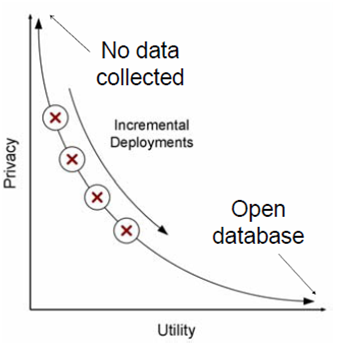

Future areas of study which may lead to improvement in this area are:
  •          Add a set of administrator-defined system-wide database queries
  •          Study explicit user privacy controls
  •          Investigate provable database privacy techniques
  •          Creation of an economic model for “pricing” queries based on privacy
  •          Study privacy models in-situ with real applications and users

Issues with RFID - 2

|
Proving the ROI


As with any other technological investment the RFID investment has high risks. The key driver to mass adoption is proven return on investment, which will require substantial end-user testing to quantify payback. 


On paper the value proposition of RFID is significant- AMR Research, Inc. was an independent research firm has released studies suggesting that the attributes of RFID, compared with other tracking technologies, will enable significant supply-chain advantages, including greater revenue from fewer stock-outs, lower labor costs through increased automation and improving inventory management from better visibility.

The significant supply chain adoption of RFID in recent years goes on to prove the utility of RFID in this area. The great excitement around the data sharing model of Wal-mart is not phony. The model has proved to be strategically beneficial to suppliers of Wal-mart.

In the eyes of RFID enthusiasts the question of RFID proving its ROI does not arise. As RFID Journal editor Mark Roberti says in his recent article the benefits provided by RFID far over-power the need to calculate ROI.

During the era of internet boom many investments were made without a slightest of doubt or ROI analysis. When the dot.com bubble burst millions were lost in thin air. This has created a sense of “once bitten twice shy” attitude. However, today some of the largest fortune 500 companies are internet based.

RFID technology, on the similar lines cannot be ignored. The value that RFID promises to provide is simply not understood by most organizations today. To accept the utility of RFID in businesses, organizations need to realize that there are areas where they are still underperforming and may improve their efficiency by using RFID technology.

Rewe group, a European retail and food group, used to have to replace 10 percent of its roll cages each year because the company had no cost-effective way to track them. Today, Rewe has deployed an RFID system  that can track roll cages in real time as they pass through dock doors, and it hopes to install the system eventually in 29 distribution centers, achieving real-time visibility into the cages' locations at all times. (See Rewe Deploying Long-Range Real-Time Location RFID System)

The point is RFID lets the organization manage what has to date, not been manageable—people, assets, tools, equipment, containers, inventory, vehicles, files and more. If businesses deploy it as an infrastructure technology, it will deliver myriad benefits over time, and then calculating an ROI on a specific application becomes less important. 

Issues with RFID - 1

|

The RFID technology has been touted as one of the most promising future technologies which will be as omnipresent in the real world as there are ‘Google’ and ‘Facebook’ on the web today. In spite of such projections there are many complications in the actual implementation of the technology, therefore stifling investments.

Majority of investments are justified by the model of Return on Investment and this, is exactly where the RFID technology fails.

In this series of articles we shall discuss various aspect involved in implementation of RFID and investment in RFID.

Price-Utility Ratio :

The cheapest RFID tags cost around 15 US cents on an average*. But the utility of these is minimal.

For an RFID tag with sophisticated sensors the cost may be as high as 100 US $. They have great utility but are impossible to produce in high volumes.

This is where the buyers of the tags discard the value proposition of RFID tags. The existing technology of bar-codes in retail is as cheap as zero US cents.

Recently two statements have been published suggesting that because the price of a barcode is so low, it is unlikely that RFID would be a viable replacement

In the one case the statement was:

"I see RFID tags replacing bar codes in [more expensive] garments, for instance. But I don't see it happening in the supermarket. People have talked about replacing U.P.C. code with RFID, but I don't think it will ever happen:  Because nothing's cheaper than zero. And it literally costs nothing to put a U.P.C. code on a package. You just integrate a bar code into your artwork and print it; it doesn't cost anything. And they're never going to bring an RFID tag down to a hundredth of a cent, or even less. Anything that it costs is going to cost more than zero."    -Trolley Scan (Pty) Ltd

While the other read:

"It’s highly unlikely that the technology will ultimately replace bar code- even with the inevitable reduction in raw material costs coupled with the economies of scale, the integrated circuit in the RF tag will never be as cheap as a barcode label."                - Trolley Scan (Pty) Ltd

Both of these commentaries seem to be based on the premise that because a barcode label is integrated into the display packaging of the product, it is very cheap. Surely the real issue is what are the productivity benefits by using an RFID tag, versus a barcode, versus a simple numeric tag?

Bar-codes have made their presence felt in society almost solely around potential productivity benefits they offer. However barcodes do not cost only the cost of the ink on the packaging. The user needs to buy sophisticated scanning equipment, information systems, and communication systems and manage databases just to be part of the user group for benefiting from machine readable labels.

On the other hand, RFID benefit not just the retailer, but all parties from the manufacturer, distributor, logistics operator, retailer and the user.  RFID is going to win its major position in these applications through real productivity enhancements and benefits for the users, which will completely outweigh that it might cost more than the price of the ink on the barcode label. The rollout of RFID as a viable replacement however is not without its hurdles, particularly the size of the project that will require many players involvement and initially only allow leading/forward-looking retailers to be involved.